For those of you interested in the cultural significance and influence of Elvis, you don't need to travel to Graceland or Vegas -- just take a trip to Palms Thai restaurant, where you can hear Thai Elvis perform. He's got the hips, the hair, and the oh-so-fabulous outfits down, not to mention his spot-on imitation of all of Elvis' vocal inflections when he sings. This place is not to be missed...
Tuesday, March 11, 2008
Thai Elvis
For those of you interested in the cultural significance and influence of Elvis, you don't need to travel to Graceland or Vegas -- just take a trip to Palms Thai restaurant, where you can hear Thai Elvis perform. He's got the hips, the hair, and the oh-so-fabulous outfits down, not to mention his spot-on imitation of all of Elvis' vocal inflections when he sings. This place is not to be missed...
Reading Response #4: Historical Truth and Popular Media
Spigel focuses on one aspect of the King's fame - his impersonators. She calls them the “holders of unofficial history” who comment back on the "confusion and alienation of our time." They embody popular memory, opposed to historical truth. This dichotomy between historical truth and popular memory is introduced on p. 180 and developed throughout the article. Whereas popular memory is defined by its multiplicity and subjectivity, historical truth is based upon a linear, black/white presentation. However, as I understand it, I don't think this delineation is accurate. Popular memory has that same sense of linearity and black/white fact as historical truth. Imagine if an Elvis impersonator were to show up in a tailored suit asserting that Elvis was, at heart, a businessman. This history of Elvis would not be permissible. Other impersonators and fans would question this depiction asking for proof or any type of evidence. They would challenge this depiction by looking at the multiple other impersonations, all of whom seem to resemble one another thereby affirming that their majority depiction of the King must be accurate, must be “the truth.” It is popular history (even more so than historical truth) that has a clear desire of answering "what really happened." American’s obsession with autobiographies, celebrity blogs, even a very class like ours that sets to understand and dissect celebrity personas are all attempts to get to the "truth." So I think to say that popular memory embraces multiple versions or interpretations of the past is incorrect - we are all still striving to embrace the one "true" story of the past. Subjectivity and multiplicity do not define popular memory, they complicate it. Do you think this is true, or do you feel that popular memory is in fact more subjective than historical truth?
Also, just a few other questions to consider that arose with the readings (perhaps we can talk about them in class):
- Sweeney mentions forms of White Trash that are accepted by mainstream (and even upper-class) audiences, what are the characteristics that make this transition possible?
- impersonators legitimize their act by having seen Elvis perform, does this mean impersonators will cease to exist once the current generation of impersonators (the last one to see Elvis perform) die? how can post-1950s fans legitimize an impersonation other than watching his films?
- Spigel asserts that Elvis impersonation mirrors religion through identification and over-identification with Elvis/God, gender hierarchy, etc., how do cults fit into this comparison?
Little girl's all grown up...
Is anyone else seriously disturbed by the type of media attention Miley Cyrus receives? Not all of the media attention, but the content of it? Just today, on perezhilton.com, she was the face to the headline "STD's Rife Among American U.S. Teenage Girls," in which Perez goes on to refer to her as a skank. Seriously, an adult man writing an internet blog about the sex life of a fifteen-year-old -- usually this is the stuff we hear about on "To Catch a Predator," but because she's a star, it's okay? I love my celebrity gossip, Us Weekly is my guilty pleasure, and I have very little sympathy for stars who whine about the paparazzi chasing them -- most of them have their managers notify the papparazzi as to where they'll be, just so they can stay photographed and relevant -- but when it comes to the way female child stars are being written about and perceived, it creeps me out. Back when Ryan Gosling and Britney Spears were on the Disney channel, they dressed like kids, acted like kids, and were mostly watched by kids. We never saw them wearing Valentino to the Oscars -- they got to be child stars, for child viewers. What message are we sending to the little girls who worship her as Hannah Montana, but then see her befriending train-wreck Lindsay Lohan, wearing couture, and sporting loads of make-up and dyed hair? What is the hurry to thrust this young girl into the world of adults? Let her get her driver's license first, maybe even reach the old age of eighteen before speculating on her sex life, Pervy Perez.
Reading Response to Sweeney's White Trash Article
To start, I had a very difficult time taking this article seriously. Whether that is because my brain is fried due to a work overload or because I simply disagree, the verdict is still out. Coming from a small farm town in Southern Illinois with 500 people, you can trust that I know all about white trash, or at least the stereotypes attributed. In high school, we even had “drive your tractor to school” days, in which they allowed John Deere tractors to be parked on the practice football field. Our mascot was the Midget, and Confederate flags decorated bedrooms, car bumpers, and t-shirts. I had never associated Elvis with white trash before reading this article, and despite being to Graceland once as a child, I really only associated the place with being haunted.
Sweeney’s argument around White Trash to me sounds completely outlandish. It reminds me of a lecture Todd Boyd once gave when speaking about Eminem. He mentions that in some cases, rap and hip-hop are not race-defined, but rather class defined. He gives Eminem as an example because Eminem grew up in projects and rapped about poverty. It’s this that allows him to be respected in the industry more than other rappers who may have grown up more privileged. As for Elvis, since he grew up in a more impoverished area as well, and borrowed from black music and dance, he was widely accepted by whites and blacks alike.
I guess the closest thing we have to an Elvis could be Britney. She’s commonly refered to as white trash with her shoe-less gas station stops, cheeto addiction, and gum chewing. In addition, it looks like she’s got a tragic ending in store just as Elvis did. What does this say about people coming from the impoverished people in the south who essentially go from rags to riches? What does this say about our society in general after such cases of social mobility causing tragedy? I find it all very interesting, yet I still see this as an issue of class in America, not race. Thoughts?
Monday, March 10, 2008
B-List Celebrities aren't worth it
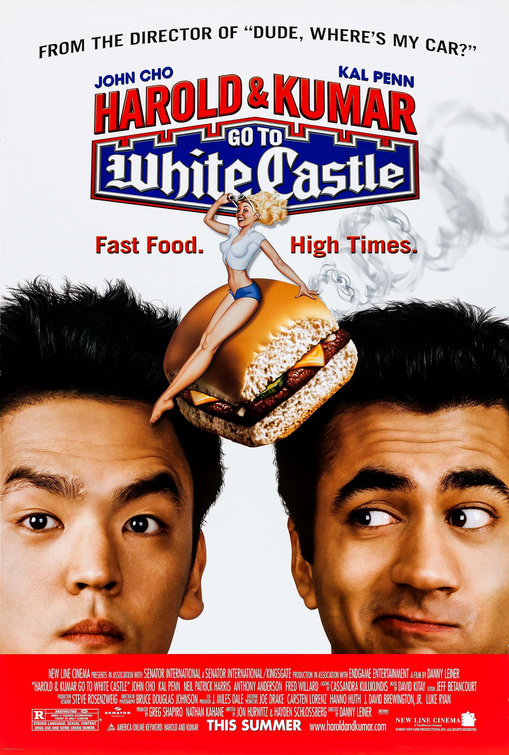
This entry will be short because I am actually taking a break from working on the midterm, BUT I thought I would share that I recently experienced an interesting celebrity sighting and even more interesting social observation from it. I was at Winston's the other night, a popular bar in West Hollywood, when I noticed John Cho (Harold & Kumar Series), sitting in the corner at a VIP table with a friend. NO ONE was paying attention to him whatsoever, and I suppose thats how it should be, he is just a normal person, living a normal life and wants to socialize on a normal Friday night. Later on that evening I get a bbm (instant message for blackberry customers) from a girlfriend of mine wanting to know if Winton's is "poppin", at this point, there are a lot of people so I tell her to come over. She and and another friend of ours arrives and greet us to which she informs us she needs to make the rounds to see if she knows anyone here. She comes back empty handed, takes one more glance around and rudely lets us know she has to stop by some other places before the night is over. Now mind you, this is a girl who loves to see and be seen. She rates a place by who is there if there is a chance of rubbing shoulders with someone famous, I'm sure in desperate hopes some male celebrity will fall in love with her and she will get to live the life of lights and glamor. Apparently, John Cho was not important enough for her or for that matter anyone else in the bar. I find this interesting: what makes a celebrity get that allure? Being Crazy? Punching Paparazzi? I mean, this guy didn't even have the paparazzi tailing him, yet he is in one of the biggest modern youth/stoner cult films ever. What reminded me about this whole incident was I at the magazine stand and he happened to be on the cover of something, I forget what publication specifically it was, but something of a household name. Ironic? I think so.
Thursday, March 6, 2008
Perez Hilton
First off, I'd just like to put it out there that I am not ashamed to admit that I am indeed one of those every so often, if not daily, visitors of Perez Hilton’s celebrity blog; and I plan on devoting the entirety of this blog to his magnetism for passing constant judgment on stars and celebrities. It’s no little known fact that Perez receives millions of hits per day, reaching both sides of the spectrum from regular people like you and me to A and Z-list celebrities (and their managers/agents/publicists) like Winona Ryder to Kathy Griffin and even more recently, musician Keith Richards. Furthermore, this just goes to show the complete coverage Perez and his blog-staffers end up dedicating to hot celebrity gossip, regardless of whether or not the particular celebrities he’s blogging and getting catty about are even worth our time (recently, he had a posting on the whereabouts on former star of TV’s Blossom, Mayim Bialik). Lately I’ve been thinking about how much of an influence he truly is in this day and age of blogging. I know this sort of comment is widely established and discussed, yet I can’t help but be in continuous awe of the power he actually wields (or perhaps the amount of power I allow him to infiltrate my life and thoughts). Obviously, his progression and catapult into the spotlight has been both negative and positive, ranging from civil litigations over slander to getting the greenlight to his own TV show on VH1, but for the most part he maintains a steady presence in the media. Today while perusing his site I noticed several postings dedicated to ailing actor Patrick Swayze, who has been diagnosed with pancreatic cancer. One of these postings in particular urges visitors of the site to follow the example of the blog-staffers who recently purchased Swayze’s Dirty Dancing 80’s hit, “She’s Like The Wind”, on iTunes as a tribute to Swayze by getting the single to #1 on the iTunes charts. Their goal as I understand is sort of a social experiment, apart from wanting to acknowledge Swayze’s lesser-known contributions to pop culture. Will it work? I asked myself. Will this seemingly forgotten, yet delicious, 80s track arise a phoenix, dust off the ash, and climb to #1 on the charts? Does Perez really have that much clout, or is he just as unsure of his own power as the rest of us and is testing the waters? Thinking back to the late-90s, I remember a time when comedian Tom Green (of MTV’s “The Tom Green Show” fame..and btw, does anyone remember Drew Barrymore being married to him?!) and TRL ruled the airwaves. On the show, Green debuted his music video for a song aptly titled, “Bum Bum Song.” He made it his personal goal to try and get his video to #1 with the likes of boybanders, ‘NSYNC, and rapper, Eminem, in all their fame and glory, and oddly enough, Green was actually successful in his quest, with the help of the ample viewers tuning into not only TRL, but also his own pre-Jackass inspired show. At that age, I was intrigued that someone of his standing and “importance” in society could get so much collective support from the youth, yet on the other hand, pondered the potential that he- or anyone of his popularity for that matter- had in making some sort of positive/contributory difference in the world. Fast forward to today and the youth is spending most, if not all, their time on the Internet instead of plopping down in front of the tube. From Tom Green to Perez Hilton, who else will receive the baton in this parade? Additionally, Perez continues to post about the state primaries and the looming presidential election and its no secret his affinity for presidential hopeful, Miss Clinton. Is having him as a widely public supporter a hit or a miss? And clearly, Perez doesn’t dictate or reflect gallup polls, but sometimes I can’t help but wonder the following: 1) how much influence I allow him/let him permeate my life and thoughts through his blog; 2) how much influence he thinks he has and; 3) how much influence Perez truly has.
Saturday, March 1, 2008
Media and a Celebrity's Safety: When is it too Far?
I know Prince Harry is not a film star, but he is a celebrity and I think what happened to him this week brings up issues that go all the way back to Elvis' military service. This week two magazines (one in Germany and one in Australia) leaked that Prince Harry has been fighting in the frontlines in Afganistan since late December. There was a strict agreement between the media and Harry's General (who let him fulfill his life's dream by fighting with his regiment) to keep this a secret for Harry's safety.No one had a clue he was over there since December and we were fine - why did the media have to compromise his safety!? I was really upset when I saw this story on CNN and every other news outlet you can imagine because I was horrified of seeing a new story the next day that the Taliban targeted Prince Harry. Luckily, he was put on a plane immediately and is now safe at home.
Celebrities have been going to war for ages. Sure Jimmy Stewart and Elvis were not political figure heads, but still they were American icons and had they been targeted in a war, it would have had an impact in American citizens' hearts (adding much fuel to the fire). Do you have an opinion on celebrities/stars going to war? What do you think about media disclosure of their whereabouts in war?